
Back in August I wrote The Personless Harness. The picture was simple: Copilot is the carriage, you are the horse, and the Brainstem is the engine. Swap the horse for the engine and the same carriage runs at a pace no stable could feed.
This week two videos landed that push on that picture from opposite sides. I want to walk through both, because together they change how I’d tell the story.
You are the next horse
David Shapiro’s You Are The Next Horse is a ten-minute history lesson with a sharp ending. In 1918, American farms had about 26.7 million horses and mules doing almost all the pulling. Within a few decades, tractors outnumbered them. The machines won for the oldest reason there is: better, faster, cheaper, safer. You couldn’t save the horse by feeding it less.
Economists have said for years that people are not horses, because we can always move up to newer, harder work. Shapiro’s answer is that the newer, harder work of the last century was thinking work, and thinking work is exactly what AI is learning to do.
Then he takes apart the line everyone repeats: “AI won’t take your job, someone using AI will.” His version of the meme is a farmer telling his horse it won’t lose its job to a tractor, but to a horse that learns to drive one. It’s absurd on purpose. The tractor never needed the horse. The teamsters really did learn to drive trucks, and that worked for a century, and now the trucks are learning to drive themselves.
His way out isn’t a skill. It’s ownership. Horses could never own a share of the tractor. People can.
Which layer are you standing on?
The second video, from DevLogic, walks through Andrej Karpathy’s funnel, and it explains why most people will hear Shapiro and shrug.
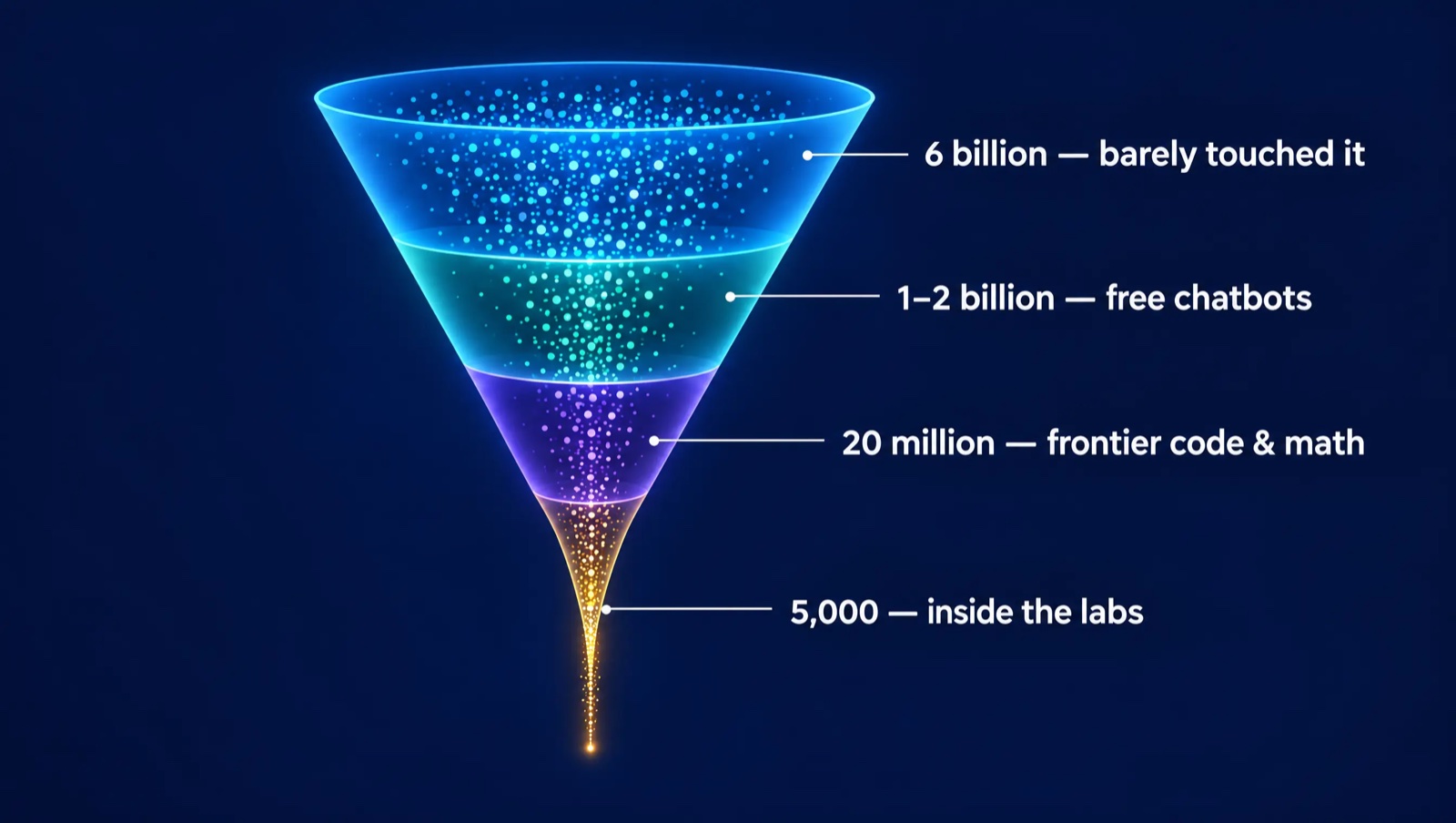
Pour the whole planet in at the top. About six billion people have barely touched these systems. One to two billion use a free chatbot now and then and see a slightly clumsy assistant. About twenty million use frontier models every day for code and math, and they watch projects that used to take weeks get done from a single prompt. At the very bottom, about five thousand people inside the labs watch swarms of agents work for weeks.
Karpathy names three things that decide where you land: how ambitious the problems you hand it are, which kinds of work it happens to be great at (digital, checkable, valuable), and which door you have access to. Each layer doesn’t see a better version of AI. It sees a different one. That’s why arguments about AI go nowhere. Both people are describing what they saw. They’re just standing at different depths.
Where my horse story was right, and where it was too soft
Reading these side by side, the Personless Harness post is a field report from the twenty-million layer. An AI agent with a real browser and a checklist ran thirty-three checks in about nineteen seconds, work that takes a person twenty minutes of full attention every single pass. That isn’t a forecast. I ran it four times in one evening.
It also lines up with Karpathy’s point about where these models are strongest. The rules I wrote for a trustworthy helper (use the real thing, check that what should be gone is gone, never fake a pass) are really rules for making work checkable. Checkable work is exactly where AI is sharpest. If you want the engine to take a job, make the job checkable first.
But my ending was too comfortable. I said the person moves from pulling to steering. Shapiro’s teamsters are that ending, and the trucks are now driving themselves. “Learn to steer” is the horse learning to drive the tractor. It buys time. It isn’t a destination.
And yet Karpathy’s funnel says the time it buys is real. Right now only about one in five hundred people can actually steer these systems. Steering is worth a lot today. It just isn’t forever.
Own the engine

So here is the version of the story I believe now.
Steering is the near-term skill. Ownership is the long-term answer. The Brainstem is where those two meet. It isn’t a smarter chat window you rent by the month. It’s a tireless second version of you that runs on your own machines, knows your tools, remembers how you like things done, and keeps working after you clock out. It’s the engine, and it’s yours.
That also answers Karpathy’s funnel, at least for one person. Most people will never climb down to the twenty-million layer by learning prompts, picking models, and wiring tools together. They shouldn’t have to. A Brainstem brings that layer to them: you talk to it, it does the work, and it shows you the proof. You get the depth without the descent.
The horse never got a share of the tractor. You can own the engine. Start with the biggest, most annoying, most checkable job on your plate, hand it over, and see how far down the funnel you really are.
Sources: David Shapiro, “You Are The Next Horse“; DevLogic, “Karpathy: The AI Understanding Gap Is Getting Worse, Fast“. Earlier in this series: The Personless Harness and The Buzzsaw.
Leave a Reply